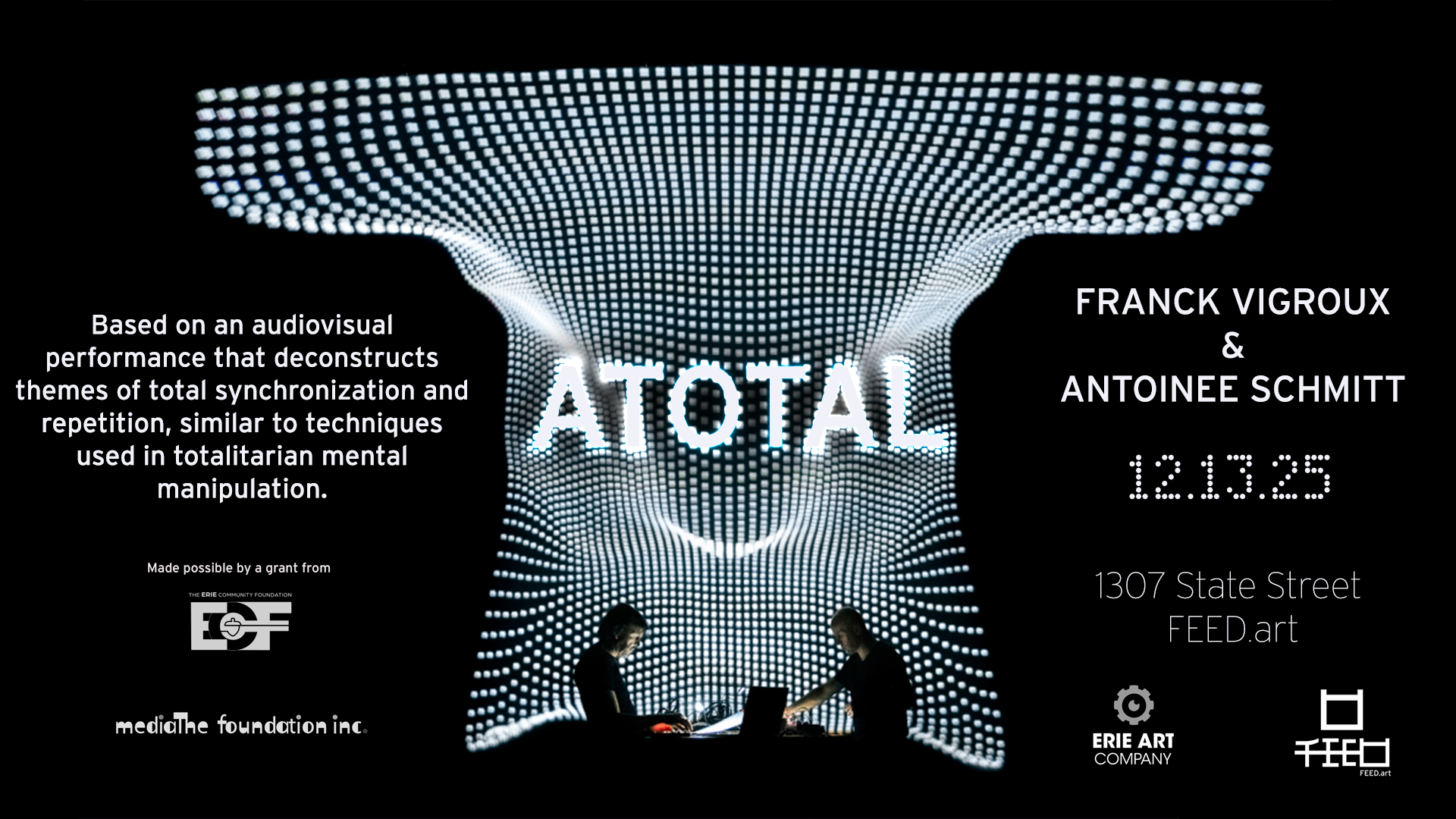
Erie, Pennsylvania Dec 9, 2025 (Issuewire.com) - ATOTAL: Sound, Light, and the Collapse of Order
Written by: Edward Patrick Kranz, PHKAKI Creative Works
News & Editorial Contribution by: Brad Ford, Gallerist, FEED Media Art Center
Location: 1307 State Street, Downtown Erie, Pennsylvania 16501
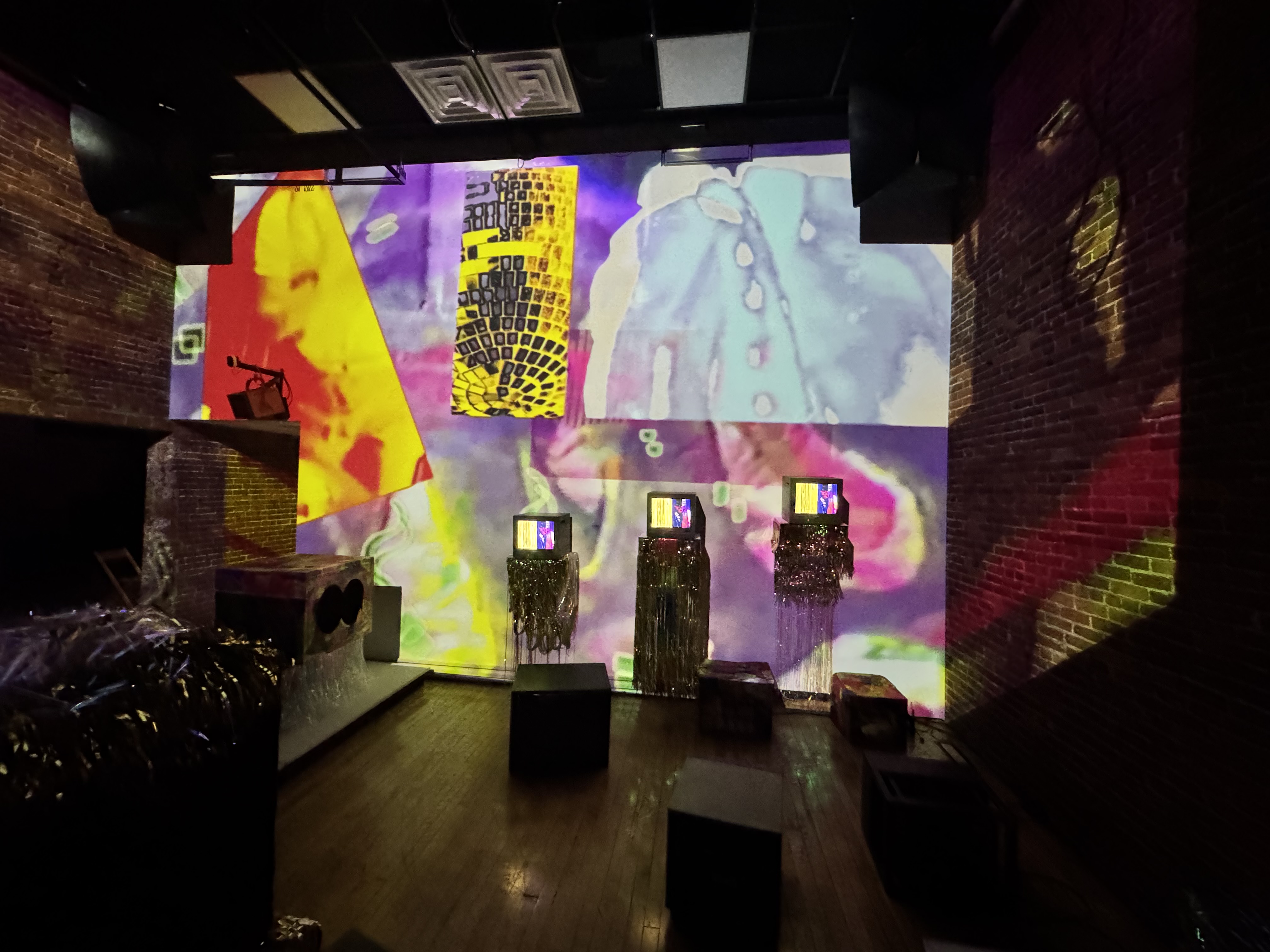
Stand inside FEEDs black box for one minute with the house lights down. The space registers as a single breath. The floor swallows reflections. The walls invite the eye to forget itself. Even with nothing on, the room has a signal. When sound arrives here, it does not echo a résumé; it meets a chamber designed for attention.
On December 13, ATOTAL: Sound, Light, and the Collapse of Order will occupy this chamber. Franck Vigroux will sculpt pressure and silence. Across from him Antoine Schmitt, a visual architect will run a live codebase that listens to the audio, then chooses how to respond. The night will be global by reputation and local by consequence. What happens in that hour matters to Erie because it declares a standard for how a city pays attention to art that refuses to flatter. Tickets:https://tickets.eriereader.com/organizations/feed-art
This article explains why that standard belongs here.
From a distance, Erie is a lake city between bigger headlines. It is described by what is near it: Cleveland, Buffalo, Pittsburgh. People who do not live here imagine winter and steel. They imagine something past its prime. Those images are not wrong, but they are incomplete. The factories left silences behind, and some of those silences became rooms for work that needs quiet.
Attention migrated. The community reorganized itself around new signals. Galleries and studios found a scale that larger markets lost. Rent did not chase artists into debt. Audiences could try a difficult night and still afford the next one. That reality is not a romance; it is logistics. It is also why a piece like ATOTAL can land with clarity here, whereas it might blur in a larger markets noise.
The Place FEED Built, and Why That Matters
More On Intelliupdate ::
- Evolution of Grinding: Why This Automated CNC Cylindrical Grinding Manufacturer Leads the High-Tech Sector
- Indian Corporate Leader Gaurav Patel Launches “Soul-Lag™” — A Book For Performers Overcome Silent Emotional Exhaustion
- Custom Substation Type Transformer Factory JIEZOU POWER: The Future of Energy with UL and CUL Certifications
- Imagen Network (IMAGE) Releases Neural Asset Guardian for Autonomous Multimedia Authentication
- Sustainability Focus: Future Leading AC-DC Power Supply Factory In China Under ErP and RoHS
FEED Media Art Center did not appear as a novelty. It arrived as an answer to a local need for a rigorous home for electronic and time-based work.
The gallery is intimate enough to hold a shared breath and technical enough to honor precise demands from artists who treat light and code like instruments. The projection plane fills peripheral vision without distortion. The sound system can ride from whisper to impact without collapsing. Staff and volunteers are trained to protect legibility rather than force spectacle. The ethos is simple: Clarity over volume. Conversation over hype.
Brad Fords vision for FEED Media Art Center is built on a specific stance, and that stance has consequences. It creates the kind of room artists cravea space where visiting practitioners can calibrate in minutes because the variables are clearly understood. Under Fords direction, the center is not merely a stage that hosts art like a guest; it is a workshop that asks art to demonstrate its method. This commitment to process over performance is why Ford has successfully brought two internationally renowned artists to Erie, facilitating a direct exchange of experience with local artists and tech-enthusiasts.
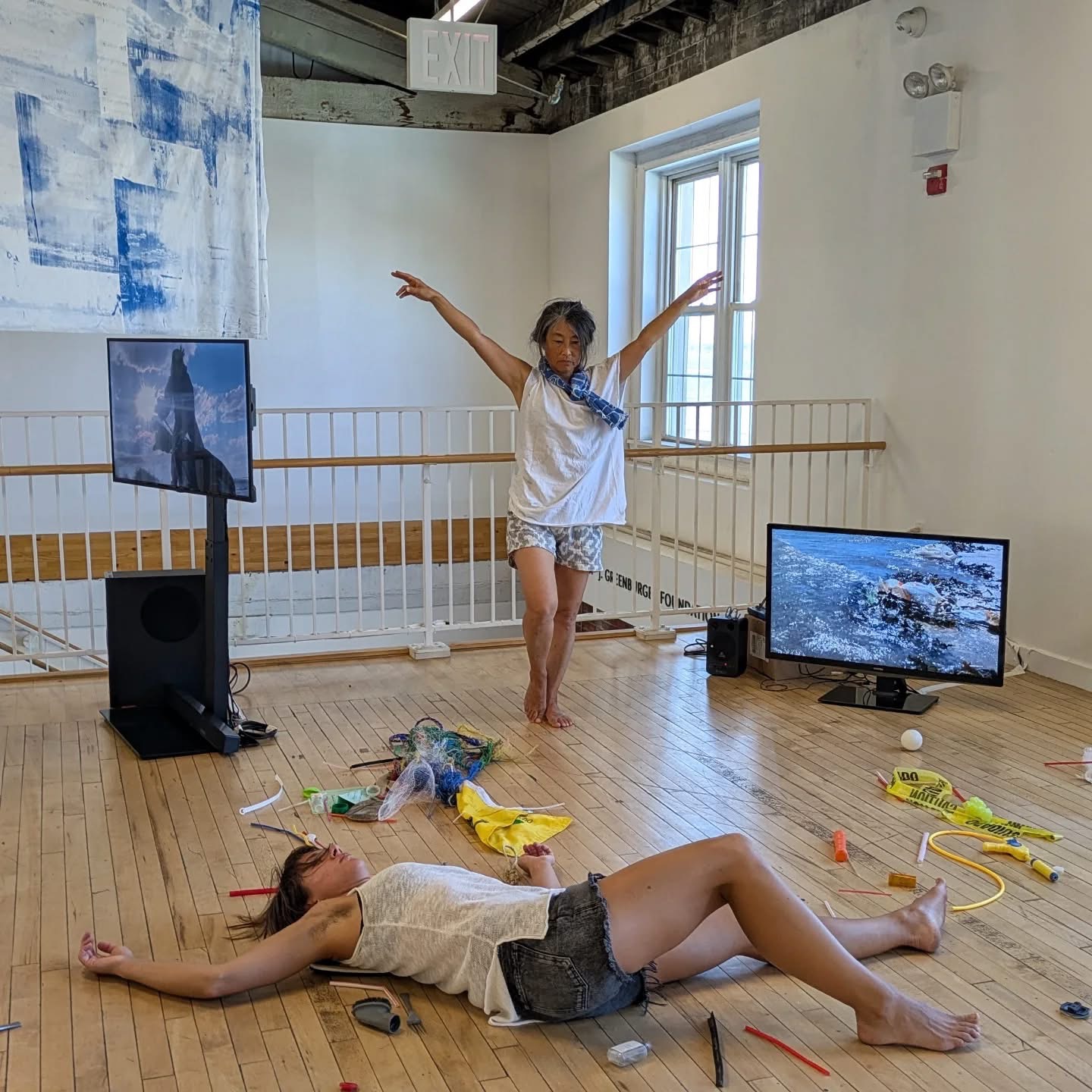
When a global project enters a local chamber like this, it lands on the pavement of Americas poorest zip code in America 16501, and the exchange becomes alchemy: the room shapes the work into something essential and raw, and the work shapes the room by filling an economic void with unquantifiable cultural volume. FEED offers a FREE SPACE for those artist and tinkers that do not have the means to rent studio space. FEED has created The SANDBOX Residency. If you're an artist yearning for the time and space to truly experiment, to get your hands dirty with new ideas, and to rediscover the joy of creation, The Sandbox offers an invaluable opportunity to play, explore, and ultimately, strengthen the foundations of your artistic practice.
Erie as Instrument, Not Backdrop
A night like ATOTAL does not ask Erie to pretend to be somewhere else. It asks Erie to be exactly what it is.
A city that knows about pressure. A city that understands drift after unity. A city that has learned to meet change without theatrics because theatrics drain the energy needed for the next day. The lake teaches patience. The winters teach endurance. The grid teaches orientation. Those are not sentimental assets. They are practical ones.
When the room fills and the first low tone arrives, Erie will respond with the attention it has been practicing for years. Quiet will sit without apology. People will let small delays read as information rather than as error. The audience will feel a permission that is rare in bigger markets. You do not have to perform your understanding. You can simply notice.
ATOTAL reaches FEED because a regional network keeps attention alive between nights. Erie Arts & Culture invests in the slow labor that builds audiences. Erie Art Company helps keep the conversation public. Libraries, schools, and small studios share calendars and gear. The language crosses boundaries easily: Musicians attend projection mapping workshops; coders sit through dance rehearsals; photographers learn how to run sound without fear. None of this looks glamorous on paper, but all of it matters when a touring artist arrives and asks for a very specific thing.
The networks ethic is local competence first. That competence attracts global trust. Artists who care about their craft are not looking for brand velocity. They are looking for rooms that do not lie.
FEED Founder, Benton Bainbridge talks about FEEDs mission like a builder, not like a marketer. He cares about how the grid is wired and how the chairs are placed. He also cares about where a night sits in a citys memory. In a short conversation about ATOTAL, he spoke in simple phrases that reveal the centers philosophy.
He said the room should never hide latency. He said lights should serve perception rather than attack it. He said Erie audiences are patient when you ask them to be patient on purpose. He said the goal is not to import novelty; the goal is to anchor standards.
What sits under those lines is a belief that generosity and rigor are the same thing when you give them enough time.
Cultural coverage in major cities often frames decentralization as a movement in need of a manifesto. Out here, it reads like the weather. The logic is straightforward: Bandwidth is scarce. Rent is lower. Rooms can be tuned with care. People know each others names. You can ask for silence and get it without a lecture. You can stage a night that depends on small timing differences and trust that nobody will hijack it for a selfie.
This is not an argument against big cities. It is a claim about scale. Some work needs friction and time. Erie offers both. The work answers by trusting Erie with premieres that carry risk. That exchange is the real story.
The Ethics of Intensity in a Small City
High-volume events in small places can ecome power plays. ATOTAL avoids that trap. Franck Vigroux uses impact to illuminate structure rather than to dominate a room.
The visual architect uses bright fields to clarify timing, then steps back. The team calibrates the space so that discomfort carries meaning and does not serve as a dare. This is an ethics lesson disguised as design. It also sets a bar for future nights. Once a city recognizes the difference between coercion and clarity, it will not easily accept the lesser choice.
Eries audience has been trained by accumulated nights, not by a single campaign. People here can sit through uncertainty without reaching for their phones. They can hold quiet without a reminder on a slide. They recognize that a late flash can be more meaningful than a thousand obedient beats. They know how to step outside after a show and let the afterimage settle before they talk.
These are not small skills. They carry back into homes, schools, and council meetings. A population that has practiced attention is a population that can handle complexity without panic. The gallery becomes a rehearsal space for civic life. That note belongs to the city as well. Eries future will not be built by erasing the interval between sound and light. It will be built by teaching people how to live inside that interval together.
Touring artists speak candidly off the record. They will tell you when a place treats them like content and when a place treats them like craft. FEED falls into the second category. Word circulates that the crew cares about legibility. Word circulates that audiences arrive ready. Word circulates that the city gives time to the work rather than draining time from it.
Those reports matter more than quotes. They bring return visits. They bring collaborations that run longer than a single night. They also raise local expectations. Erie learns to expect quality without apology. That expectation is power. It forces the rest of the cultural ecosystem to raise its own bar.
None of this happens without budgets that favor time over spectacle. These projects were made possible by a grant from The Erie Community Foundaton and MediaThe Foundation. A calibrated grid does not look impressive in a press photo, but it saves a night. A technician who knows how to seat a room is not a headline; they are the reason the headline happens. Donors who understand why a rehearsal hour is worth more than a social post are rare. Erie has a few. They deserve clear thanks and honest reporting on the returns that patience buys.
Erie matters because it lets that kind of sound exist. The city built a chamber for it. The chamber trained a public. The public now trains the work it receives. That loop is a gift and a responsibility.
On December 13, step into FEED and bring your patience. Bring the curiosity you use when the lake is flat and a wind you cannot see presses a single ripple across the surface. Bring the discipline this city teaches by necessity. Then take a seat and let a global conversation become a local act. You will not watch a product. You will watch a relationship. You will learn how unity forms, how it loosens, and how letting go can reveal more truth than holding tight.
Sometimes, the center of the art world is where you least expect it. Stand in that center for an hour. Then carry it home.
The return is simple to name. Nights that change how a person listens are more valuable than nights that trend for an hour. The latter is noise. The former is memory.
Whats Next?
A Note from Gallerist Brad Ford
FEED Media Art Center is preparing to offer new spaces for artists to experiment and evolve. The immediate focus will be on preservation: the center will spend the next few months consolidating videos, digital files, and institutional memories into a massive 9-petabyte Data Center. This archival foundation paves the way for our next initiative: a Global Virtual Residency.
Register Now for OPENFEED 2026
While digital art redefines creative practice, its practitioners are often underserved by traditional residency structures. This proposed model bridges that gap, connecting digital artists and institutions in a manner that is sustainable, innovative, and accessible. This initiative expands the institutions reach into the global digital space while maintaining logistical efficiency.
If you would like to support our programs please donate here
Media Contact:
Brad Ford
[email protected]
Edward Kranz
[email protected]
Media Contact
ERIE ART COMPANY
8144509005
1311 State Street , Erie Pa 16501
Source :ERIE ART COMPANY
This article was originally published by IssueWire. Read the original article here.
9 day's ago